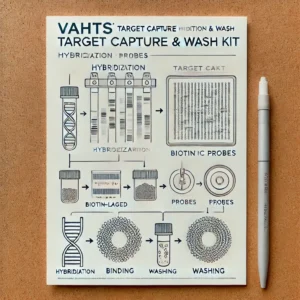
The VAHTS Target Capture Hybridization and Wash Kit is a sophisticated tool designed to enhance the efficiency and accuracy of target enrichment in genomic research. This kit is especially valuable in applications such as next-generation sequencing (NGS) where precise targeting of specific DNA or RNA sequences is crucial. The kit facilitates the hybridization of biotin-labeled probes to target sequences and the subsequent wash steps to remove non-specifically bound nucleic acids, ensuring high specificity and enrichment efficiency.
Understanding Target Capture Hybridization
Target capture hybridization is a technique that allows researchers to selectively enrich specific regions of the genome. This is particularly important in studies such as whole exome sequencing (WES) and targeted sequencing, where focusing on particular genomic regions enhances the resolution and depth of analysis. The VAHTS Target Capture Hybridization and Wash Kit is engineered to optimize this process, reducing background noise and enhancing the detection of low-frequency variants. The National Human Genome Research Institute (NHGRI) provides extensive resources on the significance of target enrichment in genomic research.
Applications in Clinical Diagnostics and Research
One of the critical applications of the VAHTS Target Capture Hybridization and Wash Kit is in clinical diagnostics, particularly for the detection of genetic mutations linked to hereditary diseases and cancers. By capturing specific genetic regions of interest, this kit enables the detailed analysis of single nucleotide polymorphisms (SNPs) and other genetic variations that may indicate disease susceptibility. The U.S. National Library of Medicine (NLM) offers a comprehensive overview of the genetic basis of various diseases and the role of targeted sequencing in diagnosis.
Enhancing Next-Generation Sequencing (NGS)
Next-generation sequencing technologies rely heavily on precise and efficient target capture. The VAHTS Target Capture Hybridization and Wash Kit is tailored to work seamlessly with NGS platforms, ensuring that only the regions of interest are sequenced. This not only improves the cost-efficiency of sequencing projects but also enhances the quality of the data obtained. Detailed protocols for integrating target capture in NGS workflows are available on the National Center for Biotechnology Information (NCBI) and GenomeWeb platforms.
Use in Personalized Medicine
Personalized medicine is an emerging field that tailors medical treatment to the individual characteristics of each patient. The ability to identify specific genetic mutations using tools like the VAHTS Target Capture Hybridization and Wash Kit is crucial in this context. For instance, the kit can be used to detect mutations that affect drug metabolism, guiding treatment decisions to improve efficacy and reduce adverse effects. The U.S. Food and Drug Administration (FDA) provides guidelines on the use of genomic data in personalized medicine, emphasizing the importance of precise and reliable genetic analysis tools.
Role in Epigenomics
Epigenomic studies involve analyzing the changes in gene expression that are not caused by alterations in the DNA sequence. The VAHTS Target Capture Hybridization and Wash Kit can be employed to enrich specific genomic regions for epigenetic modifications, such as DNA methylation and histone modifications. These studies are pivotal in understanding the mechanisms underlying complex diseases like cancer and neurological disorders. The National Cancer Institute (NCI) and Epigenomics Program provide extensive resources on the role of epigenetics in health and disease.
Key Advantages of the VAHTS Target Capture Hybridization and Wash Kit
This kit offers several advantages, including high sensitivity and specificity, which are critical for detecting rare mutations or low-abundance targets. The optimized hybridization conditions reduce non-specific binding, enhancing the accuracy of target capture. Additionally, the wash steps are designed to be stringent yet gentle, preserving the integrity of the captured nucleic acids for subsequent analysis. The National Institute of Standards and Technology (NIST) provides standard protocols and guidelines for optimizing hybridization and wash conditions to ensure reproducibility and reliability in genomic studies.
Protocol Optimization and Best Practices
To maximize the performance of the VAHTS Target Capture Hybridization and Wash Kit, it is essential to follow optimized protocols that consider factors such as probe concentration, hybridization time, and temperature. Detailed guidelines and optimization strategies can be found in resources from the Centers for Disease Control and Prevention (CDC) and NIH websites, which provide comprehensive insights into best practices for genomic assays.
Future Perspectives in Genomic Research
The continuous development of advanced tools like the VAHTS Target Capture Hybridization and Wash Kit is pushing the boundaries of what is possible in genomic research. As researchers strive to uncover the genetic basis of diseases and develop new therapies, the importance of precise and efficient target capture cannot be overstated. The Office of Science and Technology Policy (OSTP) provides forward-looking perspectives on the role of innovative technologies in advancing genomic research and personalized medicine.
Conclusion
The VAHTS Target Capture Hybridization and Wash Kit is an indispensable tool in the field of genomic research, providing unmatched precision and reliability in target enrichment. By facilitating the selective capture of specific genomic regions, this kit enhances the quality of sequencing data and the efficiency of genomic workflows. Researchers and clinicians are encouraged to explore further details and protocol optimizations available on various academic and governmental websites, such as PubMed and Grants.gov, to fully leverage the capabilities of this advanced tool in their studies.


Leave a Reply