Site-directed mutagenesis is a vital tool in molecular biology for introducing specific genetic mutations into DNA sequences. This technique is widely used to study protein structure and function, engineer enzyme activity, and develop therapeutic proteins. Rapid advancements in this field have led to more efficient and reliable mutagenesis kits, protocols, and techniques. This article explores the principles, applications, and innovations in rapid site-directed mutagenesis, enriched with references to educational and governmental resources.
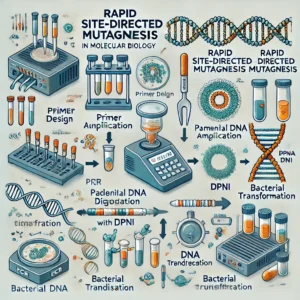
1. Target Identification and Primer Design
The first step is to identify the DNA sequence where the mutation will be introduced. This is followed by designing primers that include the desired mutation.
- Tools for Primer Design: Tools like Primer-BLAST from NCBI or MIT’s Primer Design Tools are commonly used.
- Guidelines for Mutation Placement: Visit DOE Genomics Program for tips on optimizing mutation placement.
2. PCR Amplification
PCR is the core of the mutagenesis process, amplifying the mutated sequence using the designed primers. High-fidelity polymerases ensure accuracy in replicating the target sequence.
- High-Fidelity Polymerases: Enzymes like PfuUltra II or Phusion DNA polymerases are standard. Their detailed specifications are listed at Thermo Fisher Scientific’s Educational Resources.
- PCR Optimization Tips: Consult the NIH’s PCR Optimization Guide for troubleshooting common issues like non-specific amplification.
3. Parental DNA Removal
After PCR, the parental (non-mutated) DNA is digested using restriction enzymes like DpnI, which targets methylated or hemi-methylated DNA from the template.
- Role of DpnI in Mutagenesis: Learn more about restriction enzyme applications from the New England Biolabs Educational Portal.
- Digestion Protocols: Visit Addgene’s Protocol Hub for detailed digestion protocols.
4. Transformation into Competent Cells
The amplified, mutant DNA is introduced into bacterial cells for propagation. This step ensures the mutated plasmid is ready for downstream applications.
- Competent Cell Preparation: Methods for preparing chemically competent cells are available at Cold Spring Harbor Laboratory Protocols.
- Transformation Efficiency Guidelines: Explore tips to enhance transformation efficiency from FDA Research Guidelines.
5. Screening and Validation
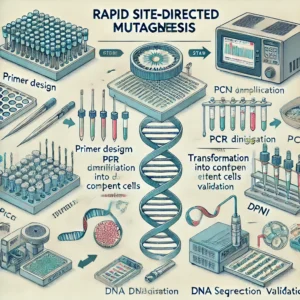
Once colonies are grown, screening methods like colony PCR or sequencing validate the introduction of mutations. Modern approaches include next-generation sequencing for higher accuracy.
- Screening Techniques: Detailed workflows can be found at Genome.gov.
- Validation Tools: Explore sequencing methodologies at NIH’s Genome Research Program.
Applications in Biotechnology and Medicine
1. Functional Protein Studies
Rapid site-directed mutagenesis allows researchers to analyze the effects of specific amino acid substitutions on protein function. For example, studies supported by the National Science Foundation (NSF) demonstrate its role in elucidating protein folding mechanisms.
2. Drug Development
Pharmaceutical companies use mutagenesis to identify drug targets and design resistance mechanisms. Case studies are available at the U.S. Food and Drug Administration (FDA).
3. Vaccine Development
Mutagenesis aids in creating attenuated viral strains for vaccines. For insights into this, visit Centers for Disease Control and Prevention (CDC).
4. Gene Therapy
Rapid site-directed mutagenesis is essential for creating gene therapy vectors that are safer and more efficient. Explore examples at the National Institutes of Health (NIH).
Advantages Over Traditional Mutagenesis
- Higher Precision: With advanced tools, the mutation rate is significantly higher while reducing off-target effects.
- Shorter Turnaround Time: Compared to older methods, rapid mutagenesis reduces experiment timelines.
- Cost-Effectiveness: Commercially available kits simplify the workflow, making it accessible even in resource-limited settings. Learn more about cost-effective strategies at Grants.gov.
Recent Innovations in Rapid Site-Directed Mutagenesis
1. CRISPR-Based Mutagenesis
The integration of CRISPR/Cas9 with mutagenesis protocols allows for targeted and multiplexed modifications. Explore CRISPR innovations at NIH CRISPR Initiative.
2. Synthetic Biology Integration
Synthetic biology tools are increasingly used for automated primer synthesis and mutation introduction. Check out synthetic biology applications at DOE Genomic Science Program.
3. AI-Driven Primer Design
AI algorithms predict optimal primer sequences, enhancing efficiency. Visit NSF’s AI in Genomics for further details.
Future Directions
Rapid site-directed mutagenesis continues to evolve with advancements in automation, high-throughput screening, and bioinformatics integration. This technique is anticipated to play an even more significant role in synthetic biology, personalized medicine, and functional genomics.
For a deeper understanding, consult resources like NCBI, CDC, and NIH.


Leave a Reply